

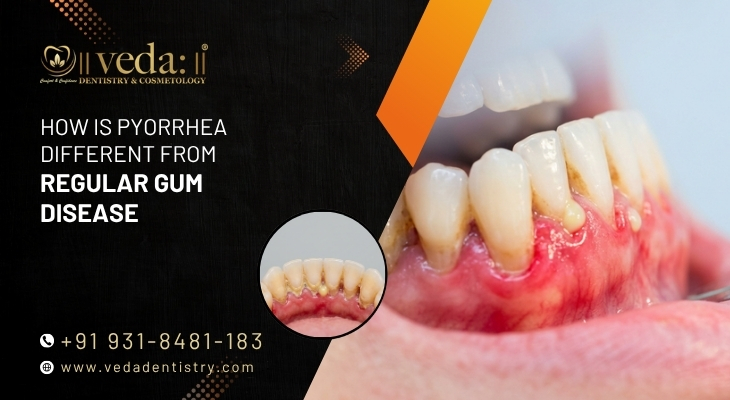
Most people have heard the words "gum disease" and mentally filed it under "things to worry about later." A little bleeding when you brush, some sensitivity, nothing serious, right? Probably just brushed too hard.
Here's the thing: gum disease exists on a spectrum. At one end, you have gingivitis: mild, reversible, very common. At the other end, you have pyorrhea, and by the time most people find out they have it, it's been quietly causing damage for years.
If your dentist has mentioned "bone loss" or "deep pockets" recently, or your gums have been looking lower than they used to, this is worth understanding properly.
Think of gum disease like a slow leak in a pipe. In the early stages (gingivitis), the damage is surface-level. The gums are inflamed, they bleed easily, but the structure underneath is still intact. Fix the leak early, and no lasting damage will be done.
Pyorrhea, the commonly used term for advanced periodontal disease, is what happens when that leak is ignored long enough. The infection moves deeper, supporting bone starts to break down, and what was once reversible becomes something that needs active, ongoing management.
The clinical term is periodontitis, and it affects roughly 40–45% of adults in India. Advanced periodontal disease represents the more severe end of that picture.
Pyorrhea is a severe, chronic gum disease where infection has progressed beyond the gum tissue into the supporting structures, the ligaments, and the alveolar bone.
Key features that distinguish it from earlier-stage gum disease:
Periodontal infection symptoms don't always announce themselves loudly. Many people with significant gum disease experience surprisingly little pain, which is exactly why it progresses so far before being caught.
| Symptom | What It Might Indicate |
|---|---|
| Bleeding gums when brushing | Early to moderate gum infection |
| Swollen and receding gums | Progressing periodontitis |
| Chronic bad breath | Subgingival bacterial biofilm buildup |
| Loose teeth from gum disease | Significant alveolar bone loss |
| Dental abscess and gum disease | Active infection in periodontal pockets |
| Gum recession | Advanced tissue and bone involvement |
Chronic bad breath that doesn't respond to brushing or mouthwash is one of the most consistent and most overlooked signs of subgingival bacterial biofilm deep in the gum pockets. It's not a hygiene issue at that point. It's a clinical one.
Diagnosis begins with a dental probing examination: a simple, painless procedure where the dentist measures periodontal pocket depth around each tooth. Healthy gums measure 1–3mm. Readings of 4mm and above indicate disease; 6mm or more suggest advanced periodontal disease.
X-rays are taken alongside probing to assess alveolar bone loss, since bone changes aren't visible during a clinical exam alone. Together, they give a complete picture of the stages of gum disease.
Pyorrhea is not curable in the sense that lost bone doesn't fully regenerate. But it is very much manageable, and when caught before the most severe stage, teeth that might otherwise be lost can often be saved.
Scaling and root planing is the first line of treatment for most cases of periodontitis. It involves deep cleaning below the gumline — removing subgingival bacterial biofilm, tartar, and infected tissue from root surfaces. Antibiotic therapy for gums is sometimes prescribed alongside, either systemically or as a localized gel placed directly into the pockets.
When pockets are too deep for non-surgical cleaning, the gum tissue is gently lifted to allow direct access to the root and bone, thoroughly cleaned, and repositioned.
Where alveolar bone loss has been significant, bone grafting helps restore lost support, improving the long-term prognosis and reducing tooth loss from gum disease.
Laser therapy targets infected tissue and bacteria with precision, reduces bleeding, and often shortens recovery compared to traditional surgery.
| Treatment | Approximate Cost |
|---|---|
| Dental Scaling & Polishing (Basic) | ₹800 – ₹2,500 |
| Scaling and Root Planing (per quadrant) | ₹1,500 – ₹5,000 |
| Periodontal Flap Surgery (per quadrant) | ₹5,000 – ₹15,000 |
| Bone Grafting | ₹8,000 – ₹20,000 |
| Laser Gum Treatment (per quadrant) | ₹3,000 – ₹25,000 |
| Gum Recession / Grafting | ₹7,500+ |
The periodontal treatment cost and the cost of gum surgery in Delhi at Veda Dentistry & Cosmetology are discussed before starting treatment, so that you get a precise picture before any treatment begins.
Tooth extraction due to infection becomes increasingly likely the longer advanced gum disease goes unmanaged. Once alveolar bone loss reaches a point where a tooth no longer has adequate support, extraction is often the only remaining option.
Beyond the mouth, research continues to strengthen the link between advanced periodontal disease and systemic conditions, including cardiovascular disease, diabetes complications, and adverse pregnancy outcomes.
Pyorrhea responds best to early, consistent treatment. The difference between catching it at the deep cleaning stage versus the bone grafting stage in both outcomes and periodontal treatment cost is significant.
At Veda Dentistry & Cosmetology, treatment starts with an honest, thorough assessment. A clear plan is built around what your gums actually need. If your gums bleed regularly, chronic bad breath hasn't improved despite good hygiene, or your dentist has mentioned bone loss, book a consultation today.
Contact Veda Dentistry & Cosmetology and take the first step toward healthier gums — before the problem takes the next step on its own.
It is primarily caused by long-term accumulation of subgingival bacterial biofilm, the bacterial plaque that hardens into tartar below the gumline and triggers chronic inflammation. Over time, this destroys gum tissue and the periodontal ligament, leading to alveolar bone loss. Contributing factors include poor oral hygiene, smoking, uncontrolled diabetes, and genetic predisposition. It's the result of stages of gum disease progressing untreated over months or years, rarely something that develops overnight.
While it isn't contagious like a cold, the bacteria responsible for severe gum infection can be transmitted through saliva. Within the same mouth, periodontal infection symptoms tend to worsen and spread to additional teeth if untreated. Alveolar bone loss that begins around one or two teeth can progress to involve the entire arch if the underlying bacterial cause isn't addressed through scaling and root planing or more advanced treatment.
Periodontitis and advanced periodontal disease most commonly develop in adults over 35, with prevalence increasing with age. However, an aggressive form can affect younger adults and even teenagers, particularly those with genetic predisposition or systemic conditions. Bleeding gums when brushing and swollen and receding gums in younger patients should never be dismissed; early dental probing examination can catch developing gum disease well before it becomes severe.
The most recognizable signs include bleeding gums when brushing, swollen and receding gums, chronic bad breath that doesn't resolve with brushing, loose teeth from gum disease, and visible gum recession. Dental abscess and gum disease occurring together signal active, advanced infection. Many people are surprised to learn their gum disease has progressed significantly because pain is often minimal until the later stages.
Not always, and this is one of the most important things to understand about gum disease. Advanced periodontal disease often progresses with little to no discomfort, which is why it goes undetected until significant alveolar bone loss has already occurred. When pain does appear — through a dental abscess and gum disease flare-up or tooth extraction due to infection — it's usually a sign the condition has reached an advanced stage. This is precisely why routine dental probing examination matters. Catching it before the pain starts is always the goal.