

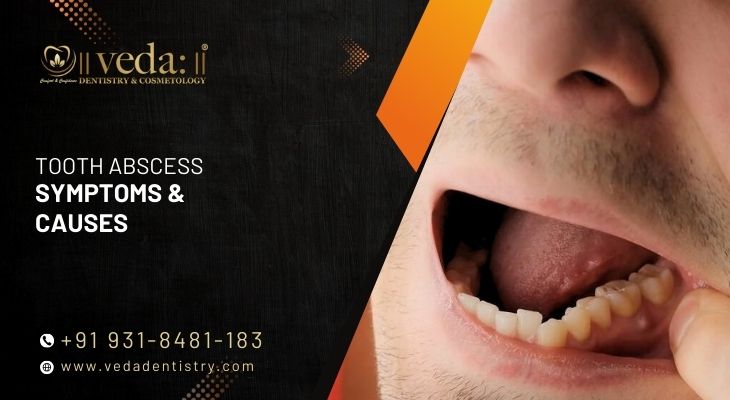
A tooth abscess rarely announces itself dramatically at first. It usually starts as something easy to dismiss: a mild ache, slight sensitivity, or a feeling that something isn’t quite right. Life goes on, painkillers help for a bit, and the problem quietly settles in.
Until it doesn’t.
A tooth abscess is not just another dental issue; it’s a sign of infection that needs timely attention. If left untreated, it can lead to serious pain, swelling, and complications that go beyond the tooth itself. Understanding the early symptoms and causes can help you act before things escalate.
At Veda Dentistry and Cosmetology, patients often arrive wishing they had known what their symptoms meant earlier. This guide breaks down tooth abscesses in a way that’s clear, practical, and easy to recognise, without unnecessary alarm or technical overload.
A tooth abscess is a pocket of pus caused by a bacterial infection. It forms when bacteria enter the tooth or surrounding tissue, and the body tries to fight it off. The result is pressure, inflammation, and pain.
Depending on where the infection develops, a tooth abscess can occur:
The common thread is infection, and infection doesn’t resolve on its own.
Most abscesses don’t appear overnight. They develop in stages, which is why they’re often ignored early on.
Stage 1: The Warning Signs
ByThis is when symptoms are mild and easy to overlook:
At this point, the infection is just beginning.
Stage 2: The Infection Takes Hold
As bacteria multiply, symptoms become harder to ignore:
This is often when patients start seeking help.
Stage 3: The Abscess Forms
Without treatment, pressure builds as pus collects:
This stage requires prompt dental care.
A tooth abscess can look different from person to person, but some symptoms are consistent.
Pain That Doesn’t Behave Normally
Abscess pain is often:
It doesn’t come and go like regular sensitivity.
Swelling in Unexpected Places
Infections don’t always stay local. Swelling may appear:
This swelling is your body responding to infection.
A Bad Taste That Won’t Go Away
If an abscess drains on its own, you may notice:
This doesn’t mean the problem is solved; the infection is still present.
Fever and Fatigue
In some cases, the body reacts more strongly:
These are signs the infection may be spreading.
Understanding the causes helps explain why abscesses are preventable in many cases.
Untreated Tooth Decay
Deep cavities allow bacteria to reach the inner pulp of the tooth. Once infected, the bacteria can travel down to the root, forming an abscess. This is one of the most common causes.
In such cases, treatments like a root canal is also recommended. And if you are looking for affordable root canal treatment in East Delhi, Veda Dentistry and Cosmetology provides transparent pricing after assessing your condition.
Gum Disease
Advanced gum disease creates pockets where bacteria thrive. Over time, these bacteria can lead to abscess formation in the surrounding tissues.
Cracked or Broken Teeth
Even small cracks can allow bacteria to enter the tooth. These cracks aren’t always visible, which is why infections sometimes seem to appear “out of nowhere.”
Impacted or Infected Wisdom Teeth Partially erupted wisdom teeth are difficult to clean and prone to infection. When bacteria get trapped, an abscess can develop around the tooth.
This is why we provide procedures like wisdom tooth extraction in East Delhi, at Veda Dentistry and Cosmetology, which are often advised when repeated infections occur.
A tooth abscess doesn’t heal on its own. Ignoring it can lead to:
Early treatment is simpler, safer, and more comfortable than delayed care.
Treatment depends on the severity and location of the infection. The goal is always the same: eliminate the infection and prevent recurrence.
Treatment may involve:
At Veda Dentistry and Cosmetology, treatment planning focuses on resolving infection effectively while preserving oral health wherever possible.
While exact costs vary, several factors influence how a tooth abscess is managed:
Early diagnosis often means simpler treatment.
A tooth abscess often causes persistent or throbbing tooth pain, swelling in the gums or face, and sensitivity to hot or cold. Some people may also notice a bad taste in the mouth or pus-like discharge near the affected tooth. If these symptoms worsen or don’t improve, it’s important to see a dentist for evaluation.
A tooth abscess does not heal on its own. Even if pain temporarily reduces or the abscess drains, the underlying infection remains. Without proper treatment, the infection can return or spread to nearby tissues.
A tooth abscess should be treated as a priority dental concern. Severe pain, swelling, fever, or difficulty opening the mouth can indicate that the infection is spreading. Seeking prompt dental care helps prevent complications and further discomfort.
Not necessarily. The treatment depends on how far the infection has spread and the condition of the affected tooth. In many cases, a root canal helps remove the infection while preserving the tooth, but other treatment options may be considered if the tooth cannot be saved.
If left untreated, a tooth abscess can lead to increasing pain, swelling, and damage to surrounding bone and tissues. In rare cases, the infection may spread beyond the mouth and cause serious health issues. Early treatment reduces these risks and improves outcomes.
A tooth abscess doesn’t start as a crisis; it becomes one when early signs are ignored. Understanding the symptoms and causes gives you the chance to act before pain and infection take control.
At Veda Dentistry and Cosmetology, the focus is on timely diagnosis, clear explanations, and appropriate treatment, so patients don’t have to deal with avoidable complications. When it comes to a tooth abscess, early attention makes all the difference.