

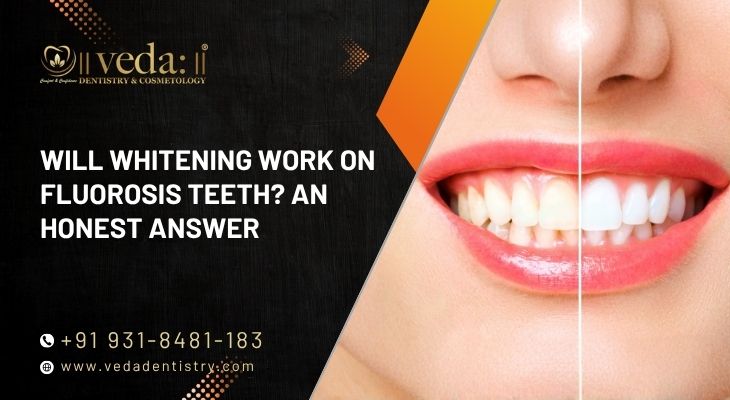
If your teeth have white or yellow patches from fluorosis, whitening alone usually won't fix them. Here's what actually does and in what order. Book a consult.
If you've grown up in parts of North India, you've probably noticed it on yourself or someone you love those faint white patches across the front teeth, sometimes with yellow or brown lines running through them. You smile in a photo, zoom in, and there they are. So you do what most people do. You Google "teeth whitening" and book a session somewhere.
Six weeks before his wedding, a patient walked into Veda asking exactly that. He wanted his teeth whitened. He wanted the yellow lines reduced. He wanted to look good in his wedding photos.
I had to tell him something his earlier dentist hadn't.
Whitening alone, on fluorosis teeth, doesn't work the way most people think it does.
The reason matters because once you understand why, the right treatment becomes obvious. And the right treatment is almost never the one most clinics push you toward.
Fluorosis isn't a surface stain. It's a developmental condition where the enamel formed unevenly during childhood, usually because of higher-than-ideal fluoride exposure. The white patches and yellow streaks aren't sitting on your teeth. They're built into the structure of the enamel itself.
So when you bleach a fluorosis tooth, the surrounding enamel often whitens, but the patches lighten unpredictably. Sometimes the contrast stays the same. Sometimes it gets worse.
That said, whitening can still be worth trying for mild fluorosis. It's conservative. It's not expensive. And occasionally it works beautifully. We just can't promise the result the way we can with normal teeth.
The real fixes the ones that work predictably depend on what kind of fluorosis stain you have and how deep it goes. There are three.
Normal enamel takes up peroxide gel evenly. The whole tooth lifts a few shades. The result is predictable.
Fluorosis enamel is structurally different. It has more porosity in some zones and dense, almost glassy patches in others. Peroxide doesn't penetrate uniformly. The result: the patch you wanted to disappear can become a brighter patch on a slightly less bright tooth.
This is why I tell every patient with fluorosis the same thing in the chair: you can try whitening, it's the most conservative and least expensive option. Sometimes it works really well. But I won't promise a shade. With normal teeth, I can. With fluorosis, the honest answer is "let's see."
That sentence loses me bookings. I'd rather lose the booking than make a promise I can't keep.
Here's the part most clinics skip. Fluorosis isn't one thing. The treatment depends on whether the staining is white or yellow, and whether it's shallow or deep.
For mild fluorosis with chalky white patches and otherwise healthy enamel, the right treatment is resin infiltration. We use a material called ICON. It flows into the porous areas of the enamel and changes how light reflects off them. The patches blend back into the surrounding tooth. No drilling. No anaesthesia. Single visit. Enamel preserved.
Probably the most under-used treatment in Indian dentistry. Most patients have never been told it exists.
For mild fluorosis with yellow or light brown surface staining, the right treatment is microabrasion, not infiltration. Microabrasion uses a controlled abrasive paste to physically remove a very thin layer of enamel, taking the discoloration with it.
The reason it works for yellow and not white is structural. Yellow stains usually sit closer to the enamel surface they can be physically removed. White patches are deeper porosity that needs to be optically rebalanced, which is what infiltration does.
For mixed cases, yellow surface staining with residual white spots underneath we sometimes combine the two. Microabrasion first to take down the yellow, then infiltration on the white patches that remain.
For severe fluorosis deep brown banding, heavy mottling, or stains that go too far into the enamel for either microabrasion or infiltration to reach porcelain veneers are the predictable fix. Lithium disilicate (e.max), about 0.5mm of enamel reduction, custom-shaded to your face. Ten to fifteen years of durability. The premium predictable option.
This is the treatment most clinics jump to first because it's the most profitable. I won't, unless your stain depth genuinely calls for it. Most fluorosis cases I see don't.
This is the part the patient was surprised by. He wanted veneers on his upper teeth. The lower teeth had crowding but he hadn't even thought about them, because they don't show in posed photos.
Here's the problem with that plan. Veneers can only be done on the upper arch in most cases. If your lower teeth are crowded and yellowish, the moment you talk not smile, talk your lower teeth show. And they'll mismatch your bright new uppers. The result looks worse than the original. It looks fake.
A smile that works in photos isn't enough. Your lower teeth show every time you speak.
So before any veneer plan, I look at the alignment of both arches. If there's crowding, spacing, or a band of tissue pulling teeth apart that gets fixed first. Aligners. 8–14 months for most adult cases. Then we whiten or treat the fluorosis. Then, only if needed, we do veneers.
Out of every three patients who walk in asking for veneers, I send two home with a different plan. Sometimes that's aligners and microabrasion or infiltration and they don't need veneers at all. The teeth, once straight and clean and stain-treated, look like the veneers they were going to pay ₹2 lakhs for.
This is what I mean when I say right-sized treatment. The most expensive plan is rarely the right one.
I want to share something that happened in a recent consult, because it shows how this gets decided in real life.
The patient had old trauma to one tooth a sensation that hadn't fully gone away. The tooth might move with aligners. Or it might not. We couldn't know without trying.
The standard play would be: book the aligners, take the full payment upfront (because that's how aligner labs work non-refundable once fabricated), and start treatment.
Instead, I suggested metal braces first. ₹60,000. Refundable structure. We'd watch the trauma tooth for 3–4 months. If it moved, we could keep going with braces, or upgrade to aligners and credit ₹50,000 toward the upgrade. If it didn't move, the patient hadn't lost a single rupee on a non-refundable aligner kit.
The first time I've offered hybrid treatment to a young patient. Not because he asked. Because the case asked for it.
For most patients with fluorosis who also have alignment concerns, the order is:
For mild fluorosis without crowding, sometimes the answer is just step 1 plus step 4. For severe fluorosis with crowding and a wedding deadline, we do all four but in this exact order, because skipping a step or doing them in the wrong order is what makes cosmetic dentistry look obvious.
For about one in five fluorosis patients with mild staining, a single whitening session paired with proper deep cleaning gives a result they're genuinely happy with.
For ₹15,000–21,000 (cleaning plus whitening), it's worth trying first as a conservative option. If you love the result, you stop there. If you don't, we already have your scans, your photos, and your starting point - and we move to microabrasion, infiltration, or veneers based on what's left.
The honest sentence I say in the chair: "Try it. See how it feels. If you're happy, we've solved this in one visit. If not, we step up - and you've lost nothing except finding out what whitening alone can do for your specific teeth."
Every fluorosis case at Veda starts with three things: an Aqua-Care cleaning to see what your teeth actually look like without surface stains, a Trios 3 intraoral scan, and a Digital Smile Design preview that shows you the planned outcome before any irreversible step.
We back every major procedure with a one-year warranty. If a veneer chips, we replace it. If aligners don't deliver, we work with the lab on a revision plan. If something needs adjustment in the first year, you don't pay again.
We also sequence honestly. We won't take aligner payment if your case needs to be watched for a few months first. We won't push veneers if microabrasion or infiltration would have given you 80% of the result for 20% of the cost.
If your fluorosis is mild and you're under 25, I'd often recommend waiting on porcelain veneers. Try microabrasion or infiltration first, see how you feel in your late twenties, then decide.
If your gums or bite are unstable, fix that foundation first.
If you're getting married in 8 weeks and you have moderate-to-severe fluorosis with crowding, I'll be honest about timeline. We can give you a beautiful result with cleaning, microabrasion or infiltration alone in time for the wedding. Aligners and veneers we plan for after, calmly, without the deadline pressure.
And if a clinic is offering you 8 veneers in two visits with no DSD preview, no scans, no discussion of microabrasion or infiltration as alternatives, no discussion of your lower teeth - walk away. That's the work that fails in 5 years.
For some patients, yes. Whitening can increase the contrast between patched and unpatched enamel, making the patches more obvious. For mild cases it's still worth trying as a conservative first step. We can't predict who it'll work for without trying.
Microabrasion physically removes a thin layer of enamel and works best for shallow yellow or brown stains. Resin infiltration changes how light reflects off the enamel without removing it, and works best for shallow white patches. For mixed cases, we sometimes do microabrasion first, then infiltration on residual white spots.
For shallow white fluorosis, often yes. For deep brown banding or severe mottling, no - infiltration won't lift colour deep enough. We assess this in consultation with photographs and sometimes a trial application.
Because veneers on a misaligned arch - especially when only the upper teeth are veneered - create a visible mismatch with the lower teeth when you talk. Straightening first gives a more natural result and often reduces the number of veneers needed.
Cleaning and whitening together typically range ₹15,000–25,000. Microabrasion and resin infiltration are quoted per case based on number of teeth. Aligners range from around ₹80,000 to ₹2 lakhs depending on complexity and brand. Porcelain veneers are priced per tooth. We confirm exact ranges in consultation after a Trios scan and DSD review.
Yes - and for many fluorosis patients, cleaning plus a single whitening session 4-6 weeks before the wedding is enough. We'd rather under-treat and exceed expectations than over-treat and cause stress in the final weeks.
Fluorosis isn't a stain you can wash away. It's a structural difference in your enamel. Whitening is a starting point you can try - not a guaranteed solution. The right plan depends on whether your stains are shallow white, shallow yellow, or deep - and on whether your teeth also need alignment.
If you've been Googling "will whitening work on my fluorosis teeth" - the answer is try it for mild cases, but don't bet your wedding on it. Start with cleaning. See what whitening does. Then we step up to microabrasion, infiltration, or veneers based on what's actually left.