

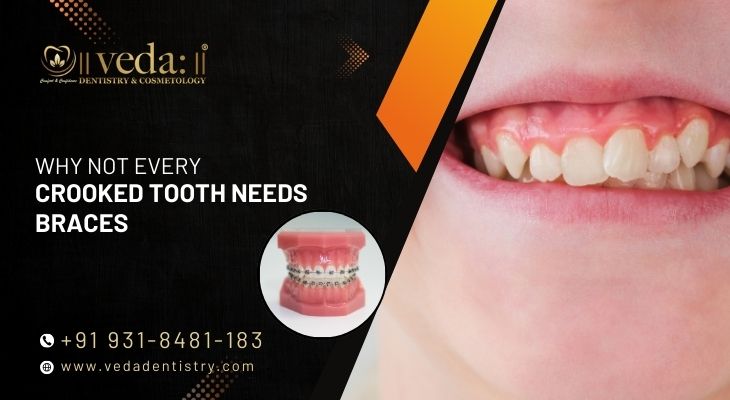
When people notice a crooked tooth, the first assumption is often that braces are necessary. For many, crooked teeth are immediately associated with orthodontic treatment, long timelines, and visible appliances.
However, the reality is more nuanced. Not every crooked tooth requires braces, and orthodontic treatment is not always the most appropriate solution.
Dentists and orthodontists evaluate far more than just appearance when deciding whether treatment is needed. They consider how the teeth function together, how easily they can be cleaned, and whether their position could affect long-term oral health.
In many cases, mild irregularities may not pose any health risk at all. Understanding when treatment is necessary, and when it may simply be optional—helps patients make informed decisions about their smile.
Teeth rarely become misaligned for a single reason. In most cases, a combination of genetic and environmental factors influences how teeth position themselves within the jaw.
One of the most common causes is genetics. Jaw size and tooth size are inherited traits, and when there is a mismatch between the two, crowding can occur. For example, a smaller jaw combined with larger teeth can create insufficient space, causing teeth to overlap or rotate.
Childhood habits can also influence alignment. Habits such as thumb sucking, prolonged pacifier use, or tongue thrusting during early development can place pressure on teeth and gradually shift their position.
Another factor is natural tooth movement with age. Teeth are not completely fixed structures, they can slowly shift over time due to changes in bite forces, bone remodeling, or the loss of support from neighboring teeth.
Finally, missing teeth can create space that allows surrounding teeth to drift. When a tooth is lost and not replaced, adjacent teeth may tilt or move into the empty space, gradually affecting alignment.
Understanding the cause of crooked teeth helps dentists determine whether treatment is necessary and what type of intervention may be appropriate.
While some misalignment may be purely cosmetic, certain situations do require orthodontic correction because they affect oral health or function.
One of the most important factors is bite alignment. If the upper and lower teeth do not meet properly, chewing forces may become uneven. Over time, this imbalance can lead to excessive wear, fractures, or discomfort in the jaw joints.
Severe crowding is another common reason for treatment. When teeth overlap significantly, cleaning between them becomes difficult. Plaque can accumulate in these areas, increasing the risk of tooth decay and gum disease.
Orthodontic treatment may also be recommended when crooked teeth make oral hygiene difficult to maintain. Even with careful brushing and flossing, certain areas may remain inaccessible if teeth are too tightly crowded.
In some cases, misalignment can contribute to jaw discomfort or uneven tooth wear. Teeth that are not positioned correctly may receive more pressure during chewing, leading to gradual structural damage.
When these functional or health-related concerns are present, orthodontic treatment often provides significant long-term benefits.
Not all irregularities in tooth alignment create health problems. Some people have mild rotations or small gaps that do not interfere with chewing, oral hygiene, or jaw function.
For example, a slightly rotated tooth or minor spacing between teeth may be noticeable visually but may not affect dental health at all. In these cases, orthodontic treatment becomes a personal or aesthetic decision rather than a medical necessity.
Many adults choose orthodontic treatment to improve smile symmetry or confidence. Others may decide that their mild irregularities are acceptable and prefer to avoid treatment if it does not provide a functional benefit.
Both choices can be valid, depending on the individual situation and the patient’s priorities.
The key is understanding whether the alignment issue has the potential to create long-term problems or whether it is primarily cosmetic.
At Veda Dentistry , every orthodontic evaluation begins with a comprehensive assessment of both function and aesthetics.
This includes a detailed bite analysis to evaluate how the upper and lower teeth interact during chewing and jaw movement. Digital scans and imaging allow us to examine tooth position, spacing, and alignment with precision.
Equally important is understanding the patient’s concerns and goals. Some patients seek treatment for functional reasons, while others are primarily interested in improving smile appearance.
Our philosophy is simple: treatment should be recommended only when it offers real benefit. When orthodontic correction can improve oral health, function, or long-term stability, we discuss the most appropriate options. When irregularities are minor and stable, we may recommend monitoring instead of immediate treatment.
This patient-centered approach ensures that treatment decisions are thoughtful, transparent, and tailored to each individual.