

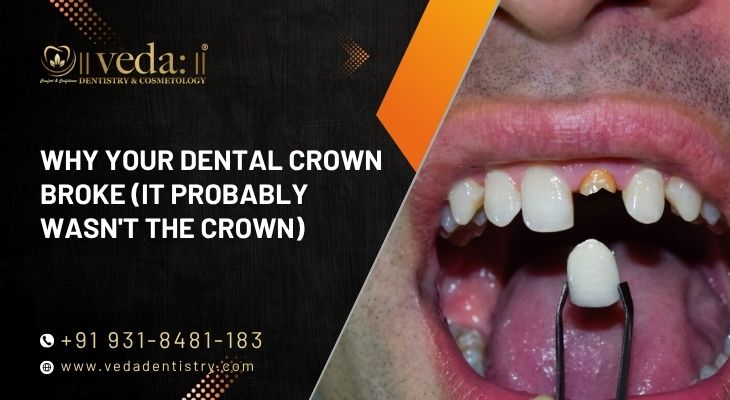
Most dental crowns don't fail because of the crown itself. They fail because the tooth underneath was already compromised — by decay, fracture, or an uncorrected bite. The lab warranty covers the crown material only. It doesn't cover what happens to the tooth beneath it. That distinction changes everything.
A patient came in this week. Fifty years old. His crown broke eating bread.
He was convinced the lab had made a defective crown. When I removed it — the crown was completely intact. Not a single crack in the porcelain.
What had failed was the tooth underneath.
This is the most misunderstood thing about crown failures. And if you've had a crown break, or you're about to get one placed, it matters that you understand it.
When a crown breaks, the first thing I look at is the tooth underneath — not the crown itself.
In this case, I found a fractured tooth root and significant decay that had eaten through what remained of the tooth structure. The crown had been sitting on a foundation that was already failing. It was only a matter of time.
Think of it like a perfectly tiled wall sitting on a crumbling wall behind it. The tiles aren't the problem. The structure they're attached to is.
In fifteen years of practice, almost every crown failure I've seen comes down to one — or a combination — of these three things.
This patient had all three. His bite had collapsed. Every tooth in his mouth showed the wear pattern of long-term grinding. The crown failure was the first visible sign of something that had been building for years.
Lab warranties — five years, fifteen years — cover one thing: the material the lab fabricated. If the porcelain cracks due to a manufacturing defect, the lab takes responsibility.
They don't cover your tooth. They don't cover your bite. They don't cover what bruxism does to a restoration over time. That's outside their scope — reasonably so. They made the crown. They weren't in the room when your bite was assessed.
So when a patient says "but it has a warranty" — I have to gently explain: the crown probably hasn't failed. The tooth beneath it has. And that's a different problem entirely.
At Veda, we offer our own one-year warranty on top of the lab warranty. But more importantly, that warranty creates a discipline: we don't place a crown without properly assessing what it's going into.
Three things we check before we begin:
This patient left with a proper plan. Not just a replacement crown dropped into the same broken environment. A plan that addresses the bite, the grinding, and the failing teeth in the right order.
If your crown failed and your dentist's immediate suggestion is another crown — without examining the tooth underneath, without checking your bite, without asking about grinding — ask more questions.
A new crown in a broken environment is the same problem on a delayed timeline.
The question that changes everything isn't how do I replace it. It's why did it fail.
Lab warranties cover manufacturing defects in the material — not what happens to the tooth underneath. If there was decay, fracture, or bite-related stress, those are clinical factors outside the lab's scope.
Flat or chipped tooth edges, waking with a sore jaw or headaches, unexplained tooth sensitivity. Many patients with bruxism only find out when a dentist identifies the wear pattern.
Our warranty covers the clinical work we do — preparation, bite adjustment, fitment, cementation. It's separate from, and in addition to, the lab's material warranty.
Possibly. One broken crown can be an isolated event. Multiple worn or failing teeth usually point to a systemic issue — bite, bruxism, or both — that needs to be addressed across the whole mouth.
If your crown broke — come in. Let's find out why before we replace anything.
Book a consultation with Dr. Shruti → WhatsApp us to schedule. No pressure. Just answers.