

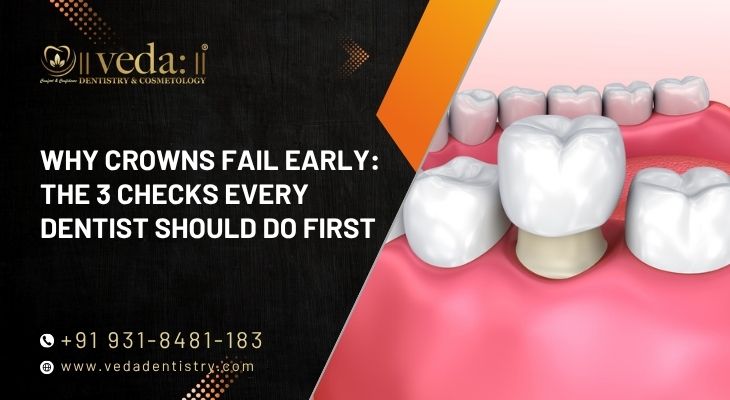
Most patients believe that if a dental crown breaks, cracks, or falls off within a few years, the crown itself must have been poor quality. But in reality, early crown failure is rarely caused by the ceramic material alone. Modern crown materials are extremely durable when selected and used correctly. A properly planned and well-executed crown should comfortably last 10–15 years or even longer. When crowns fail within two or three years, the real issue usually began before the crown was ever placed.
At Veda Dentistry, we believe crowns do not fail because of bad luck. They fail because important structural and functional problems were never identified or corrected during treatment planning.
Patients often focus only on the visible part—the ceramic crown sitting above the gums. But the crown itself is only the outer protective layer. The real question every dentist should ask before treatment is:
What is this crown sitting on?
If the tooth underneath is weak, if the bite forces are unstable, or if grinding habits are ignored, even the most expensive crown will eventually fail.
That is why diagnosis matters more than the crown material itself.
This is the first—and most important—check before recommending crown treatment.
By the time a tooth requires a crown, it has usually already lost a significant amount of natural structure because of:
The success of the crown depends heavily on how much healthy tooth structure still remains underneath.
Two things are especially important:
If the remaining tooth walls are too thin, they flex slightly every time you bite. That flexing may seem microscopic, but repeated stress over thousands of chewing cycles gradually creates cracks inside the tooth.
Over time, those cracks grow larger until the tooth fractures underneath the crown. This is why many patients are surprised when they return with a "broken crown" only to learn that the crown itself is still perfectly intact—the actual fracture occurred in the weakened tooth underneath.
Dentists use the term ferrule to describe the ring of healthy tooth structure above the gumline that wraps around the tooth.
Ideally, a crown needs approximately 1.5–2 mm of healthy tooth height all around for stable retention. This creates a protective bracing effect that helps the tooth resist fracture under pressure.
Without enough ferrule, the crown may initially feel fine but becomes mechanically unstable over time.
At Veda Dentistry, we carefully evaluate whether enough healthy structure remains before recommending a crown. In some situations, the tooth may require:
And sometimes, the honest answer is that the tooth no longer has enough structure left for another crown to succeed predictably.
In those cases, repeatedly replacing crowns only delays future failure. A may actually provide a safer and longer-lasting solution.
This is one of the most overlooked reasons crowns fail early.
A crown can look beautiful, fit perfectly, and still crack because the bite forces acting on it were never properly evaluated.
Your teeth are designed to distribute chewing pressure evenly across the entire dental arch. In a balanced bite, no single tooth carries excessive force alone.
But if one crown sits even slightly higher than the surrounding teeth, it absorbs far more pressure every day than it was designed to handle.
Over time, this can lead to:
Many patients think the crown failed "suddenly" while eating something soft like bread or rice. In reality, the damage was building silently for months or years because the bite overload was never corrected.
Most patients assume dentists only check how teeth meet when biting down. But side-to-side jaw movements are equally important.
During normal chewing, the front teeth should guide movement while the back teeth separate slightly. If a back crown catches during these sliding movements, it experiences strong sideways forces it was never designed to tolerate.
This creates long-term stress on both the crown and the tooth underneath.
At Veda Dentistry, every crown is evaluated in both straight biting and dynamic jaw movement before final cementation.
We use:
to identify pressure points and overload areas before they become future failures.
This process takes more time, but it often adds years to the lifespan of the restoration.
This is the most commonly missed reason crowns fail prematurely.
Many patients grind or clench their teeth during sleep without knowing it. They may never hear grinding sounds or wake up with pain, but the wear patterns on their teeth often reveal the habit clearly.
Grinding creates forces far beyond normal chewing pressure. These forces are repeated night after night, for hours at a time.
Even the strongest materials eventually weaken under that level of constant overload.
Common signs of grinding include:
For patients with grinding habits, a custom nightguard is not an optional accessory—it is protection.
A nightguard absorbs and redistributes force before it reaches the crown and underlying tooth. In many cases, it becomes the difference between a crown lasting 15 years versus failing within 18–24 months.
This is the conversation many clinics avoid because it is easier to simply replace the crown again.
But repeated crown failures are often signs of larger underlying problems involving:
If those issues are not corrected, placing another crown changes nothing.
Depending on the situation, the healthier long-term solution may involve:
Good dentistry is not about placing crowns quickly.
It is about deciding whether a crown is truly the right treatment to begin with.
Before any major crown treatment at Veda Dentistry, we perform:
If we identify a problem, we address it before placing the crown—not after it fails.
This philosophy is also why we confidently provide our on treatment.
Crowns rarely fail because the ceramic material was weak.
They usually fail because:
The crown itself is only the final layer.
The real success of crown treatment depends on the planning, diagnosis, and functional evaluation that happen before the crown is ever made.
Because ultimately, the crown is not the part that determines whether it lasts.
The foundation underneath it does.