

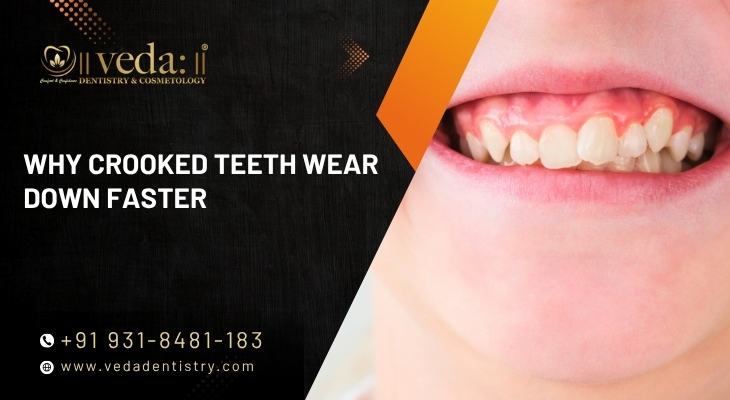
Learn why crooked teeth wear down faster due to uneven bite forces. Discover how alignment affects enamel wear and how to prevent long-term damage.
Tooth wear is often attributed to aging or habits like grinding. While these factors do play a role, many cases of excessive wear have a less obvious cause: crooked or misaligned teeth.
Alignment is not just about appearance, it directly affects how forces are distributed across your teeth every time you bite, chew, or even speak. When this balance is disrupted, certain teeth begin to take on more stress than they are designed to handle.
Understanding this connection between alignment and wear is essential for preventing long-term damage and preserving natural tooth structure.
In a healthy, well-aligned bite, teeth work together as a coordinated system. When you chew, forces are distributed evenly across multiple teeth, preventing any single tooth from being overloaded.
This balance protects the enamel, the outer protective layer of the tooth, from excessive stress. It also ensures that the jaw muscles and joints function efficiently without strain.
Additionally, the front teeth and back teeth have specific roles. Back teeth handle most of the chewing forces, while front teeth guide movements like biting and sliding. When this harmony is maintained, teeth can function comfortably and remain stable over time.
When teeth are misaligned, this natural balance is disrupted.
Certain teeth may come into contact earlier than others during biting. These early contacts create pressure points where force becomes concentrated instead of evenly distributed.
As a result, some teeth end up bearing more load than they are designed for, while others are underutilised. This imbalance may not be immediately noticeable, but it has a cumulative effect over time.
Even small misalignments can create repeated stress in the same areas, gradually affecting the structure of the teeth.
When force is concentrated on specific teeth, the enamel begins to wear down more quickly in those areas.
Over time, this can lead to:
Unlike natural, gradual wear that occurs evenly across the teeth, this type of wear is localized and progressive. It often affects certain teeth more than others, leading to noticeable differences in shape and height.
As enamel thins, the underlying dentin becomes more exposed, which can increase sensitivity to temperature and pressure.
If uneven wear continues without intervention, the damage can become more significant.
Teeth may lose their natural contours, edges may become irregular, and bite relationships may worsen further. In advanced cases, restorative treatments such as bonding, crowns, or even full-mouth rehabilitation may be required to rebuild lost structure.
What begins as a minor alignment issue can gradually develop into a more complex functional problem if left unaddressed.
The good news is that early recognition and appropriate management can prevent or slow down this process.
A bite analysis helps identify areas where forces are unevenly distributed. Based on this evaluation, dentists can recommend solutions tailored to the individual case.
In some situations, minor orthodontic correction can improve alignment and restore balanced force distribution. Even small adjustments can significantly reduce stress on specific teeth.
If teeth grinding (bruxism) is also present, a custom nightguard may be recommended to protect teeth from excessive pressure during sleep.
Regular monitoring of wear patterns during dental check-ups allows early detection of changes, enabling timely intervention before significant damage occurs.
At Veda Dentistry, we evaluate tooth wear as part of a comprehensive assessment of bite and function.
Rather than treating only the visible damage, we focus on identifying the underlying cause, whether it is misalignment, bite imbalance, or parafunctional habits such as grinding.
By addressing these factors early, we aim to preserve natural tooth structure and minimise the need for extensive restorative treatment in the future.
Crooked teeth do more than affect the appearance of your smile—they influence how your teeth function every day.
When bite forces are uneven, certain teeth are placed under excessive stress, leading to faster wear and long-term damage.
Recognising this early and addressing alignment or bite issues can help protect your enamel, maintain comfort, and preserve your natural teeth for years to come.
If you've noticed uneven wear or sensitivity, a professional evaluation can help identify the cause and guide the right preventive approach.