

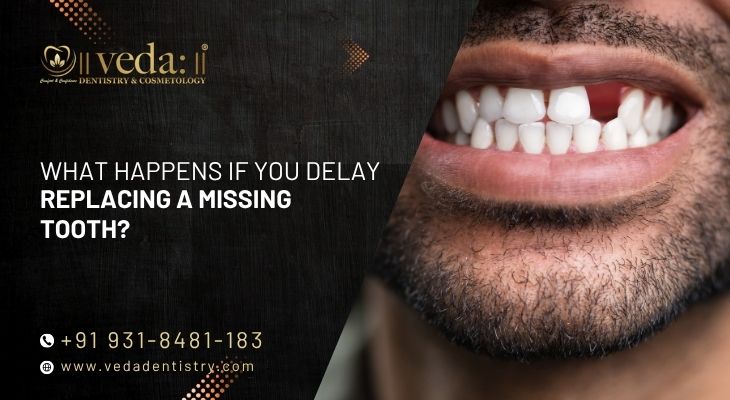
Delaying tooth replacement can lead to bone loss, shifting teeth, and bite problems. Learn why timely replacement is important for long-term oral health.
Losing a tooth is often seen as a purely cosmetic concern, especially if it's not immediately visible when you smile. Many patients choose to delay replacement, assuming it won't have a significant impact on their oral health.
However, a missing tooth sets off a chain of changes inside the mouth that are not always obvious at first. These changes affect not only the surrounding teeth, but also the bone, bite, and overall stability of your smile.
Understanding what happens over time can help you make a more informed decision about when, and why, to replace a missing tooth.
One of the most important roles of a tooth is to stimulate the jawbone during chewing. This stimulation keeps the bone active and maintains its volume and density.
When a tooth is lost, that stimulation disappears. As a result, the bone in that area begins to shrink, a process known as bone resorption.
This bone loss can begin within months of losing a tooth and continues gradually over time. As the bone reduces in height and width, it can affect facial structure and make future treatments, such as dental implants, more complex.
In some cases, delayed replacement may require additional procedures like bone grafting to rebuild lost bone before an implant can be placed.
Teeth are designed to support each other in a balanced arrangement. When one tooth is missing, the surrounding teeth begin to move into the empty space.
The adjacent teeth may tilt or drift, while the opposing tooth (the one above or below the gap) may begin to over-erupt into the space.
This shifting can disrupt alignment, create uneven spacing, and make future replacement more complicated. It can also affect how your teeth come together when you bite.
As teeth shift and positions change, the bite becomes less stable. Instead of forces being evenly distributed across multiple teeth, certain areas begin to experience more pressure than others.
Over time, this imbalance can lead to excessive wear, chipping, or sensitivity in overloaded teeth. Patients may also experience jaw discomfort or muscle fatigue due to the uneven distribution of forces.
What begins as a single missing tooth can gradually affect the function of the entire bite.
Gaps created by missing teeth can trap food particles more easily, making oral hygiene more challenging. Misaligned or tilted teeth are also harder to clean effectively.
These factors increase the risk of plaque accumulation, which can lead to tooth decay and gum disease in the surrounding teeth.
As oral hygiene becomes more difficult, the health of the entire mouth can be affected, not just the area of the missing tooth.
Beyond functional concerns, missing teeth can also impact facial aesthetics. Bone loss in the jaw may lead to subtle changes in facial structure over time, such as a sunken appearance in the affected area.
Depending on the location of the missing tooth, gaps may also affect your smile, speech, and overall confidence in social or professional settings.
Replacing a missing tooth early helps prevent many of these changes from occurring.
Options such as dental implants, bridges, or other restorative solutions can restore function, maintain bone levels, and preserve the alignment of surrounding teeth.
Early intervention is often simpler, less invasive, and more cost-effective compared to treating complications that develop over time.
At Veda Dentistry, we evaluate each case carefully to determine the most appropriate replacement option based on bone condition, bite, and overall oral health.
Using advanced diagnostics and digital planning, we aim to restore missing teeth in a way that maintains long-term stability and function, not just immediate aesthetics.
A missing tooth is not an isolated issue, it affects the entire oral system over time.
Delaying replacement can lead to bone loss, shifting teeth, bite problems, and increased risk of further dental complications.
Addressing the problem early helps preserve both oral health and long-term treatment options.
If you have a missing tooth, consulting your dentist early can help you protect your smile before small changes become larger concerns.