

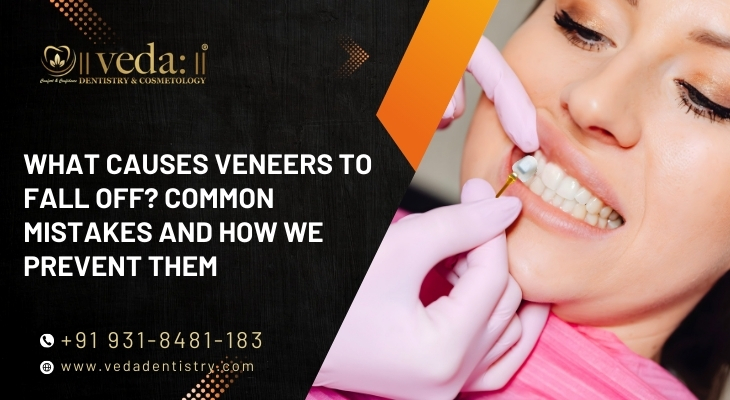
Do veneers fall off easily? Learn the real reasons veneers fail and how proper planning, bite analysis, and secure bonding make veneers long-lasting.
If you are researching veneers, chances are you have come across alarming stories online, veneers popping off during meals, cracked smiles, or patients regretting their decision after cosmetic treatment.
These stories can make veneers sound fragile or unreliable. In reality, the truth is far more reassuring.
Veneers do not randomly fall off. When they fail, there is almost always a clear and preventable reason behind it. In most cases, the issue is not the veneer itself but the planning, bonding technique, or underlying dental conditions that were overlooked before treatment began.
When veneers are designed properly, bonded correctly, and placed on a stable bite, they are one of the most predictable and durable cosmetic dental treatments available.
Understanding why veneers sometimes fail, and how those problems can be prevented, helps patients make informed decisions about their smile.
Modern veneers are bonded using advanced adhesive systems that create a strong, durable connection between the porcelain and the tooth surface. This bonding process works best when the veneer attaches to healthy enamel, which provides an ideal surface for adhesive strength.
In simple terms, veneers do not sit loosely on the teeth like caps. They are chemically bonded to the enamel using dental adhesives designed to withstand daily chewing forces.
When bonding protocols are followed correctly, veneers can last many years while maintaining both strength and aesthetics. Many long-term studies show that well-planned veneers can function successfully for more than a decade.
However, veneers depend heavily on proper technique and planning. If the underlying tooth surface is weak, if the bite places excessive stress on the restoration, or if bonding conditions are compromised during placement, the veneer may debond prematurely.
This is why veneer longevity is less about the porcelain itself and more about the foundation it is placed on.
Although veneer failure is uncommon when treatment is performed correctly, several avoidable mistakes can significantly increase the risk of debonding or damage.
The strongest veneer bonds occur when the restoration is attached primarily to enamel. If excessive tooth reduction exposes large areas of dentin, the adhesive bond becomes weaker and more susceptible to failure.
Similarly, teeth with large existing fillings, cracks, or structural damage may not provide an ideal bonding surface unless they are properly reinforced beforehand.
A conservative preparation that preserves as much natural enamel as possible is essential for long-term veneer success.
One of the most overlooked causes of veneer failure is bite imbalance. If the upper and lower teeth do not meet harmoniously, certain teeth may experience excessive pressure during chewing or clenching.
This concentrated force can eventually weaken the adhesive interface, causing the veneer to chip or detach. In some cases, patients unknowingly grind or clench their teeth at night, placing additional stress on the restorations.
Without addressing bite stability first, even perfectly crafted veneers may be exposed to forces they were never designed to withstand.
Smile design requires careful planning. When cosmetic procedures are rushed without a trial smile or mock-up, the final shape and length of veneers may not align properly with the patient’s bite or facial proportions.
Improperly designed veneers can create premature contacts between teeth, increasing stress during normal function. Over time, this can lead to chipping, debonding, or discomfort.
A preview of the proposed smile allows adjustments to be made before permanent bonding begins.
Successful veneer bonding requires a dry and controlled environment. Saliva contamination during the bonding process can interfere with adhesive chemistry and weaken the bond between the tooth and the veneer.
For this reason, dentists often use rubber dams or other isolation techniques to maintain a clean, moisture-free field while placing veneers.
Small technical details during bonding can make a significant difference in the long-term stability of the restoration.
Many patients assume veneers fail because of weak materials. In reality, most failures are caused by excessive force rather than material limitations.
A helpful analogy is to imagine repeatedly bending a metal paperclip. The paperclip does not break immediately, but repeated stress in the same location eventually causes it to snap.
Teeth experience similar repetitive forces every day. When bite forces are balanced across multiple teeth, the pressure is shared evenly and restorations remain stable.
However, if one tooth absorbs a disproportionate amount of force, the veneer attached to it may gradually weaken or detach.
This is why bite evaluation is such an important part of cosmetic dentistry. By identifying pressure points and correcting alignment issues beforehand, dentists can significantly reduce the risk of veneer complications.
At Veda Dentistry, veneer treatment is approached as a comprehensive smile rehabilitation rather than a quick cosmetic procedure.
Every case begins with a detailed smile analysis that considers facial proportions, gum health, and tooth structure. Bite relationships are carefully evaluated to ensure that chewing forces are evenly distributed across the teeth.
We prioritise a conservative, enamel-preserving approach whenever possible. Preserving natural tooth structure not only protects the health of the tooth but also improves the strength and durability of the veneer bond.
Secure bonding protocols are followed using controlled isolation techniques to ensure optimal adhesive performance.
Equally important is ethical case selection. Not every cosmetic concern should be treated with veneers. In some cases, orthodontic alignment or other treatments may provide a healthier and more predictable solution before veneers are considered.
If veneers repeatedly fall off, the problem is rarely the veneer itself.
More often, the underlying issue involves bite imbalance, misalignment, grinding habits, or compromised tooth structure that was not addressed before treatment.
Veneers are designed to enhance healthy teeth, not compensate for unresolved structural or functional problems.
Correcting these factors first greatly improves both the longevity and comfort of cosmetic restorations.
When done correctly, veneers can be life-changing. They improve smile symmetry, restore confidence, and enhance facial aesthetics in a natural and conservative way.
The fear surrounding veneers usually comes from examples of poor planning or rushed dentistry, not from the treatment itself.
With proper evaluation, careful design, and precise bonding techniques, veneers can remain stable and beautiful for many years.
If you are considering veneers, ask your dentist about bonding protocols, bite analysis, and long-term planning. These steps are the key to ensuring your new smile is not only beautiful, but also durable.