

Dental implant surgery is often associated with one silent fear in patients’ minds:
“What if it goes wrong?”
What if the implant touches a nerve? What if it enters the sinus? What if healing becomes complicated?
Modern implant dentistry exists to answer those fears, not with reassurance alone, but with evidence, visibility, and precision. This is where 3D CBCT scans have completely transformed implant planning, turning a once judgment-based procedure into a carefully guided, predictable science.
At Veda Dentistry y, every implant begins long before surgery, with a detailed 3D scan and a plan measured in millimetres.
Earlier in dentistry, implants were often planned using 2D X-rays and clinical estimation. While experienced clinicians could achieve good results, there was always an element of uncertainty.
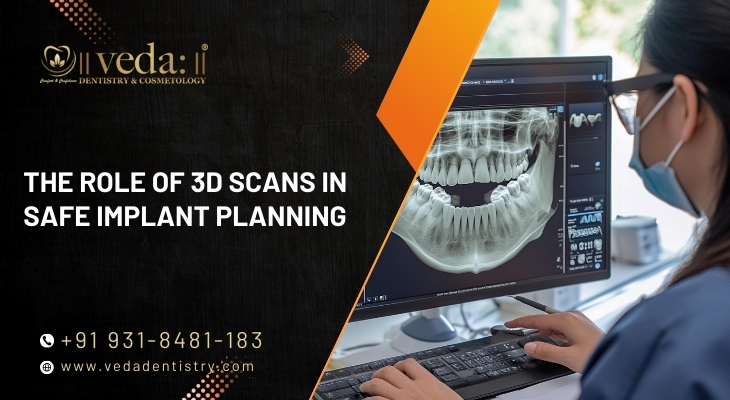
With one scan, I can see your jaw in three dimensions, not just the teeth, but the bone height, width, density, nerve pathways, and sinus position. This clarity allows me to plan implants with confidence, accuracy, and safety.
When I can see everything clearly, there is no need to “hope” things will go right. We know they will.
In the lower jaw lies the inferior alveolar nerve, which controls sensation to the lip and chin. In the upper jaw, the maxillary sinus often sits very close to where implants are needed.
Even a small error in judgment can lead to numbness, discomfort, or sinus complications, outcomes no patient should ever have to face.
With 3D imaging, I can measure exact safe distances before surgery. I select the implant size, depth, and angulation only after confirming that vital structures are well protected.
For me, this step is not optional. It’s a standard of care.
Once the CBCT scan is complete, I digitally plan the implant on specialized software.
This means the implant is placed virtually first. I evaluate:
By the time we reach surgery, every decision has already been made calmly, carefully, and deliberately.
From this digital plan, a custom 3D-printed surgical guide is created. This guide fits precisely in your mouth and directs the implant placement to the exact position we planned.
It controls:
For patients, this translates into a noticeably gentler experience:
Many patients tell me they expected implant surgery to feel much more intense, and are surprised by how smooth and controlled it actually is.
When implants are planned digitally and placed using a guide, patients experience:
But beyond physical benefits, what matters most is peace of mind, knowing your treatment was planned, not improvised.
At Veda Dentistry, every implant case is planned before surgery begins. I combine advanced imaging with clinical experience and ethical judgment to ensure treatment is predictable and patient-centred.
Technology does not replace expertise, it supports it. And when both work together, outcomes become safer, calmer, and more reliable.
Today, implant dentistry is no longer just a manual skill. It is a guided, data-driven process. 3D scans have transformed implants from a procedure that depended on estimation into one that is mapped, measured, and planned with precision.
Implant safety is not about luck.
It is about planning.
If you are considering dental implants and want a process that prioritizes safety, accuracy, and comfort, I invite you to experience 3D-guided implant planning at Veda Dentistry , where every decision is made before surgery, and every step is taken with care.