

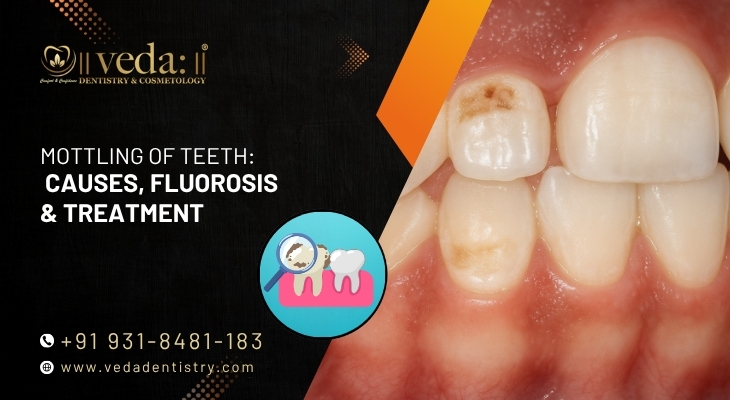
Most people who have white or brown spots on their teeth assume they did something wrong. Too much tea. Not enough brushing. Some childhood habits they barely remember. What almost nobody tells them is that in many parts of India, the water itself is the most likely cause. Elevated fluoride in groundwater is a documented reality across hundreds of districts, and the mottling of teeth it produces is one of the most common and most misunderstood findings we see at Veda Dentistry and Cosmetology in Delhi. The spots are not a hygiene failure. They are a geological one.
Most patients who walk in with this have been living with it for years, often convinced that standard whitening will fix it. It usually will not, and understanding why starts with understanding what actually happened to the enamel during those early years of tooth development.
Teeth form during childhood, and the enamel that covers them is laid down during development before the tooth is ever visible. Anything that disrupts this process leaves a permanent mark.
When enamel formation goes smoothly, it is hard, dense, and translucent. When disrupted by excess fluoride, illness, or nutritional gaps, some areas become too opaque or too porous, developing surface pitting or a chalky texture.
Two conditions worth knowing about:
Both can look similar, but have different causes and respond differently to treatment.
Fluoride is genuinely good for teeth in small amounts. It strengthens enamel and makes it more resistant to acid. What is less discussed is what happens when fluoride levels are too high during the years that teeth are forming.
Dental fluorosis occurs when a child ingests excessive fluoride while their teeth are still developing. This is not caused by brushing too much. The source is almost always drinking water.
In many Indian states, including parts of Tamil Nadu, Andhra Pradesh, Rajasthan, and Gujarat, groundwater fluoride levels exceed the safe threshold of 1.5 mg per litre. In some areas, levels reach four to five times that amount. Children who grow up drinking this water often develop enamel fluorosis by the time their permanent teeth come in.
Severity levels and what they look like:
| Severity | What You See on the Tooth |
|---|---|
| Mild | Faint white lines or patches, mostly on back teeth |
| Moderate | White spots that cover more of the tooth surface |
| Severe | Brown staining, enamel pitting, rough surface texture |
The brown staining in severe fluorosis is not decay. It is the result of the porous enamel absorbing surface pigments over time. The tooth structure underneath is still intact.
Fluorosis accounts for many mottling of teeth cases we see, but it is not the only explanation. Understanding which condition is present determines which treatment makes sense.
White spots can be caused by:
Brown stains can be caused by:
Not all brown stains look the same clinically, and not all respond to the same treatment.
Mottling of teeth is the term that specifically describes the patchy, uneven discoloration caused by fluorosis. Patches of chalky white sitting alongside streaks of brown, some areas smooth and some rough. It tends to affect teeth symmetrically because both sides of the mouth developed under the same conditions.
Key features that help identify mottling of teeth:
This pattern is the clinical fingerprint of fluorosis. When we see it, it changes what we recommend.
This is where many patients have received confusing or incomplete information. The approach depends entirely on the severity of the mottling of teeth and what the patient wants to achieve.
For mild to moderate cases:
For moderate to severe cases:
What does not help:
Not every case of mottling of teeth needs immediate intervention. Understanding the causes of white spots or brown patches is the most useful first step. Mild fluorosis that does not bother the patient aesthetically requires monitoring, not necessarily treatment.
The time to seek an assessment is when:
At Veda Dentistry and Cosmetology, our enamel discoloration treatment and dental fluorosis treatment approach always begins with a proper diagnosis. Knowing the specific cause is what makes treatment effective rather than generic.
Not always. White spots can also result from enamel hypoplasia, early-stage tooth decay, or plaque buildup around braces. However, in areas with high groundwater fluoride levels, enamel fluorosis is by far the most common explanation for white spots appearing symmetrically across multiple teeth. A clinical assessment is the most reliable way to identify the actual cause.
Yes, in many cases, though the approach depends on severity. Microabrasion works well for surface-level fluoride staining, while veneers are more suitable for deeper or more extensive discoloration. Dental fluorosis treatment is not a single procedure but a range of options that are matched to each case individually.
Teeth whitening can reduce the visual contrast between white spots and the surrounding tooth in some cases, but it does not remove the spots themselves. For significant tooth surface discoloration, whitening is often used alongside other options rather than as a standalone solution.
In mild fluorosis, the enamel is often denser than usual, not weaker. In moderate to severe cases, enamel pitting can make it more vulnerable to staining. Enamel remineralization therapy can help restore some structural density.
As soon as causes of white spots are noticed on permanent teeth, an assessment is worthwhile. Early enamel remineralization can prevent mild cases from progressing, and identifying the cause early means that treatment options remain broader. Smile correction stains cosmetic treatment, whether for white or brown spots, is most reliable after the mid-teens, once permanent teeth have fully erupted.
White and brown spots on teeth are rarely random. They record something that happened during the years the teeth were forming, sometimes decades before the patient ever noticed them. Mottling of teeth is particularly worth understanding in the context of where you live and what water you grew up drinking.
At Veda Dentistry and Cosmetology in Delhi, we see fluorosis regularly, and we have developed an approach to dental fluorosis treatment, enamel discoloration treatment, and smile correction stains that starts with the cause, not the cosmetic outcome. Because the treatment that works for fluorosis is not the same as the one that works for decay-related spots. Getting that distinction right is what makes the difference between a result that lasts and one that does not.