

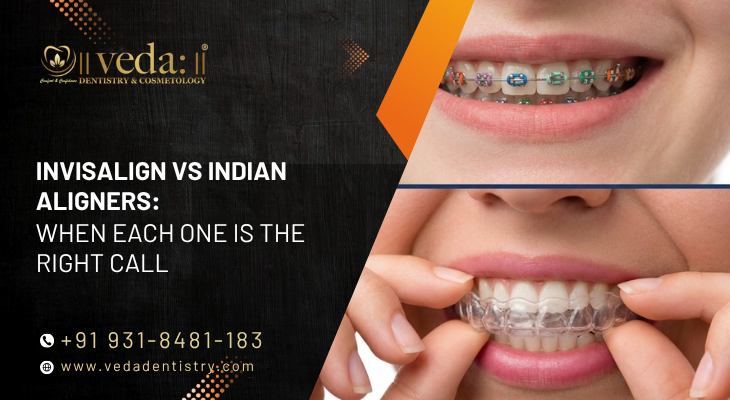
Invisalign typically costs ₹1.2L–₹2.8L. Indian aligner brands like Illusion typically cost ₹60K–₹1.8L. The right choice isn't about the price tag — it's about case complexity. Simpler cases do well on Indian brands. Complex cases need Invisalign's predictability. Some patients get the best result from a hybrid approach: braces first, aligners later.
I'm Dr. Shruti Goel. I've been practising for over fifteen years, and I completed my Fellowship in Orthodontics from Progressive Orthodontic Seminars (USA) — which is where I learned to think about aligner cases the way I'm about to share with you.
Almost every aligner consultation at Veda starts with the same question.
"Doctor, what's the difference between Invisalign and the cheaper Indian aligners? Is the expensive one really worth it?"
It's a fair question. The price gap is real. Invisalign sits in the ₹1.2L–₹2.8L range. Good Indian brands sit between ₹60K and ₹1.8L. That's a ₹60,000 to ₹1,00,000 swing — sometimes more.
Here's how I actually think about it.
I work with three categories of patients when it comes to aligners. The right brand depends on which one you fall into.
If you have mild crowding, small spacing issues, or minor relapse after old orthodontic work — your case doesn't need Invisalign's premium engineering.
I work with Illusion Aligners for most of my Indian-brand cases. They're a well-established company, the aligners are produced at fair rates, and their customer service is consistent. That last point matters more than patients realise — if a tray needs to be remade or a refinement is needed mid-treatment, you want a company that responds quickly.
For simpler cases, choosing Indian aligners isn't a compromise. It's the right-sized choice.
Some cases need movements that are harder to predict. Severe crowding. Bite corrections. Cases where teeth need to rotate significantly. Cases where multiple complex movements happen at the same time.
For these, Invisalign's track record is genuinely better. Their material, their software, their case-planning system — built up over decades and millions of cases — gives me more predictability in the chair. And predictability matters when you're investing 12–18 months of your life in treatment.
If budget isn't a constraint, and you have a complex case, Invisalign is the honest recommendation.
Here's the path most patients don't know exists.
If you have a moderately complex case but the budget for full Invisalign isn't realistic, I'll often recommend a hybrid plan. Start with traditional braces for four to five months — this handles the heavy mechanical work that aligners struggle with cheaply and efficiently. Then transition to clear aligners for the finishing phase.
You get the mechanical strength of braces where you need it. You get the aesthetic finish of aligners where it matters. The total cost lands well below full Invisalign, and the outcome is often comparable.
This isn't a workaround. For the right patient, it's the cleanest plan.
Patients often assume the gap between ₹1.5L and ₹2.5L is just brand premium. It isn't.
Invisalign's higher cost reflects three things: their proprietary SmartTrack material (which holds tooth movements more reliably than standard aligner plastics), their ClinCheck planning software (which lets me show you a digital preview of every stage of movement before you commit), and their refinement guarantee (which covers additional trays if your teeth don't track exactly as planned).
Indian brands are catching up on materials and software. For straightforward cases, the difference is often invisible in the final result. For complex cases, it shows up.
At Veda, every aligner consult starts with a Trios 3 intraoral scan and a Digital Smile Design preview. You see your predicted outcome before you commit to any brand. We then walk you through which brand fits your case — and where you fall in the three categories above.
If a simpler case walks in and a patient asks for Invisalign, I'll tell them honestly that Illusion will do the same job for less. If a complex case walks in and a patient asks for the cheapest option, I'll explain why that's the wrong economy.
That's right-sizing. And it's the whole point of how we work.
For simpler cases, yes — the outcome is comparable. For complex cases involving severe crowding, significant rotations, or bite corrections, Invisalign's predictability is still better.
Invisalign in Delhi typically ranges from ₹1.2L to ₹2.8L depending on case complexity and the number of aligners needed.
It's possible but expensive — you essentially restart planning. The better approach is choosing the right brand at the start. A proper scan and case assessment prevents this.
You start with traditional braces for four to five months to handle major movements, then transition to clear aligners for the finishing phase. It costs less than full Invisalign and works well for moderately complex cases.
A 3D scan and orthodontic assessment will tell you. Severe crowding, significant bite issues, or multiple complex movements together usually indicate a complex case.
Book a Smile Consultation at Veda — I'll personally assess your case, show you the predicted outcome, and recommend the brand and approach that's right-sized for your teeth and your budget.
Or WhatsApp us your concerns first. No pressure, just answers.
Smile. Freely.