

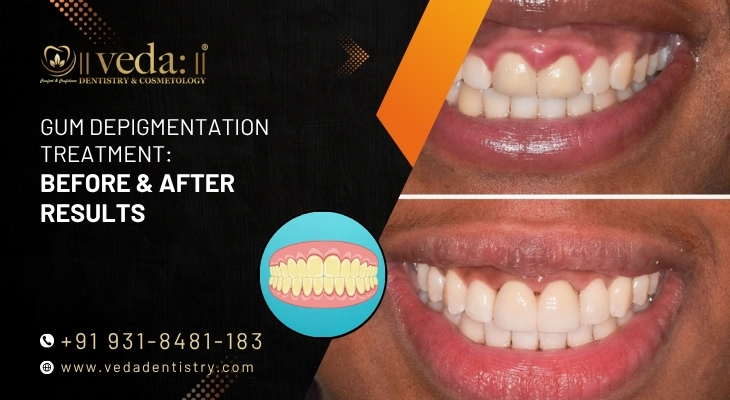
Most smile makeover conversations start and end with teeth: whitening, veneers, aligners. The gums barely get a mention. But spend five minutes looking at before and after photos of gum depigmentation results, and something clicks: the gum line was doing a lot more work on the overall appearance of that smile than anyone gave it credit for.
Dark or uneven gums aren't a health problem. For most people, it's simply melanin pigmentation, the same pigment that determines skin tone, showing up in the gum tissue. Completely normal. But if it's been making you hesitant to smile openly, laugh freely, or look at your own photos without wincing a little, that's worth doing something about.
At Veda Dentistry & Cosmetology, gum depigmentation treatment consistently ranks among the procedures patients wish they'd discovered sooner. The results are visible, the process is straightforward, and the difference it makes in how a smile looks and how confident someone feels is genuinely hard to overstate.
Here's everything you need to know.
Before getting into the treatment, it helps to understand what's actually causing the discoloration, because not all dark gums have the same origin story.
The most common cause, and the most misunderstood. Many people, particularly those with South Asian, African, Middle Eastern, or Mediterranean heritage, naturally have higher melanin pigmentation in their gum tissue. This is completely normal physiologically. It doesn't indicate any health problem. But for people who are bothered by the appearance, gingival depigmentation offers a straightforward solution.
Smoker's melanosis refers to tobacco-induced gum discoloration caused by chronic smoking or tobacco use. Nicotine stimulates melanin-producing cells in the gum tissue, leading to dark spots and patches on gums that deepen over time. Black gums treatment in these cases is effective, though results last longer when tobacco use is reduced or stopped.
Certain medications, including some antimalarials, antipsychotics, and chemotherapy drugs, can cause drug-induced gingival pigmentation as a side effect. If you've noticed gum darkening after starting a new medication, this could be why.
Amalgam tattoos from old dental fillings, certain systemic conditions, and post-inflammatory changes can all contribute to dark spots and patches on gums.
A proper evaluation at Veda Dentistry & Cosmetology will identify exactly what's causing your specific pigmentation before recommending treatment.
Gum depigmentation is the process of removing or reducing excess melanin from the surface layer of gum tissue, revealing the naturally lighter, pink tissue underneath. Think of it as resurfacing. The darker outer layer is carefully removed, and the gum tissue that regenerates in its place contains significantly less pigmentation.
The result? Gums that are noticeably lighter, more even in color, and far more aesthetically harmonious with the rest of your smile.
Laser gum depigmentation is the gold standard, and for good reason. A specialized dental laser targets and ablates the pigmented gum tissue with remarkable precision, leaving surrounding healthy tissue completely unaffected.
Why patients love it:
Laser gum depigmentation is the most popular choice at Veda Dentistry & Cosmetology, and it's easy to see why; the combination of precision, comfort, and recovery time is hard to beat.
For patients where laser isn't the most suitable option, surgical gum depigmentation treatment involves carefully removing the pigmented layer using scalpels or abrasion techniques. It's equally effective and has a long track record. Recovery takes slightly longer than the laser approach, but the results are just as significant.
This is the question everyone really wants answered. Here's an honest picture:
Before: Gums that appear brown, dark, or patchy, sometimes uniformly dark, sometimes with uneven dark spots and patches on gums scattered across the gum line. For many patients, this has been a consistent source of hesitation when smiling, laughing, or taking photos.
Immediately after: The treated area will look lighter but may appear slightly raw or sensitive as healing begins. This is completely normal; the surface tissue is regenerating.
Two to four weeks after: The new gum tissue has regenerated, and the color difference becomes clearly visible. Gums appear noticeably pinker, more uniform, and significantly more aesthetically balanced.
Final result: A smile where the gums complement the teeth rather than competing with them. Patients consistently describe feeling more confident smiling openly, and many say it's the first time they've genuinely liked how their smile looks in photos.
How long does gum depigmentation last is one of the most common questions, and the answer is: it depends on the cause.
For genetic gum pigmentation and physiological gingival pigmentation, results from laser gum depigmentation typically last several years, and in many cases, much longer. Repigmentation can occur over time as melanin-producing cells become active again, but a touch-up session addresses this easily.
For tobacco-induced gum discoloration (smoker's melanosis), results last significantly longer when tobacco use is reduced or eliminated. Continuing to smoke will accelerate repigmentation.
For drug-induced gingival pigmentation, managing the underlying medication situation (in consultation with your physician) plays a role in how long results are maintained.
| Treatment Method | Estimated Cost |
|---|---|
| Laser Gum Depigmentation | ₹10,000 – ₹25,000 |
| Surgical / Other Methods | ₹3,000 – ₹10,000 |
| Per Session / Per Arch | ₹4,000 – ₹8,000 per area |
Gum depigmentation cost varies based on the method used, the extent of pigmentation, and how many arches or areas are being treated. At Veda Dentistry & Cosmetology, costs are discussed transparently before any treatment begins, so you know exactly what you're looking at before committing to anything.
Recovery after gum depigmentation is generally smooth and manageable. Here's a realistic picture of the first week or two:
The laser method tends to involve a faster, more comfortable recovery compared to surgical approaches, which is one of the primary reasons it's the preferred choice for most patients.
The procedure is performed under local anaesthesia, so there's no pain during treatment itself. Mild discomfort after gum treatment is normal for a day or two afterwards, similar to the soreness you'd feel after any minor dental procedure. Most patients manage this comfortably with prescribed pain relief and find the recovery far easier than they anticipated.
Repigmentation is possible over time, particularly for genetic gum pigmentation and smoker's melanosis. However, it's gradual, not overnight, and a simple touch-up session at Veda Dentistry & Cosmetology restores results effectively. For tobacco-induced gum discoloration, reducing or stopping tobacco use significantly extends how long results last. How long does gum depigmentation last ultimately depends on the cause and your lifestyle habits post-treatment.
For most patients, laser gum depigmentation is the preferred approach; it's more precise, involves less bleeding, and typically means faster recovery after gum depigmentation. That said, surgical methods are equally effective and have a strong track record. The best approach for you depends on the extent of your melanin pigmentation, your gum tissue characteristics, and what your dentist recommends after a thorough evaluation.
Yes, black gums treatment is absolutely available for smokers, and results can be very significant. The important thing to remember is that tobacco-induced gum discoloration tends to recur more quickly if smoking continues after treatment, since nicotine continues to stimulate melanin production. Many patients use their gum lightening treatment results as motivation to cut back or quit, which also benefits their overall oral and general health.
In most cases, gingival depigmentation is completed in a single session. The number of areas treated: upper arch, lower arch, or both, affects the overall time and gum depigmentation cost, but the procedure itself is typically done in one appointment. Severely pigmented cases or very large treatment areas may occasionally require a follow-up session, but this is the exception rather than the rule. Your dentist at Veda Dentistry & Cosmetology will give you a clear picture during your initial consultation.
Dark or uneven gums don't get nearly enough attention in the smile makeover conversation, but for the people living with them, they can be a daily source of self-consciousness that holds back a perfectly good smile.
Gum depigmentation changes that. Whether it's genetic gum pigmentation, smoker's melanosis, or drug-induced gingival pigmentation, the treatment is well-established, the results are visible, and the process is far more comfortable than most people expect going in.
At Veda Dentistry & Cosmetology, every gum depigmentation treatment starts with understanding exactly what's causing your pigmentation and mapping out the most effective, personalized approach to treating it.
Book your consultation at Veda Dentistry & Cosmetology today, and find out what your smile looks like when your gums finally match your confidence.