

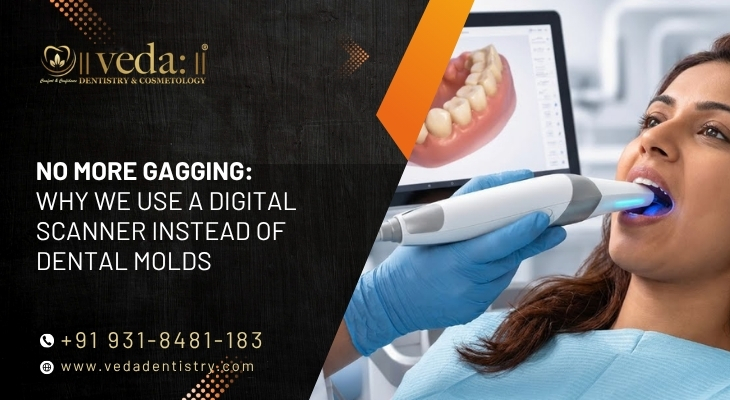
An intraoral scanner is a small handheld wand that takes thousands of photographs inside your mouth and builds a precise 3D digital model of your teeth — in minutes. No trays. No material. No gagging. At Veda Dentistry in East Delhi, we use the Trios 3, one of the most accurate scanners available.
You know the moment. The dentist brings out a U-shaped tray loaded with pink or white putty. You're told to bite down and hold still. For the next 90 seconds, you're trying not to gag, not to drool, not to think about the taste as the material sets and the clock ticks.
It's one of the most complained-about parts of any dental visit. And for a lot of patients, especially those who already find dentistry anxiety-inducing, it's the thing they quietly dread more than the drill.
At Veda, we don't use impression trays. Haven't for years.
We use the Trios 3 intraoral scanner instead of a small handheld wand that scans your teeth digitally, builds a precise 3D model in minutes, and shows you the result on screen before you leave the chair.
Many patients specifically search for a clinic with an intraoral scanner in Delhi because they want a more comfortable alternative to traditional dental impressions. At Veda, our Trios 3 scanner in Delhi workflow allows us to capture highly accurate digital records without trays, putty, or waiting for physical models. For patients looking for no dental molds, this technology has become one of the most appreciated parts of the treatment experience.
Here's what that actually means for you.
Traditional dental impressions work by pressing a soft material against your teeth and gums, letting it set, and then sending the hardened mold to a lab. From there, the lab pours plaster or resin into the mold, creates a physical cast, and uses it to plan your treatment or fabricate your restorations.
The process has been around for decades. And it has problems that have never really been solved, just accepted.
The Trios 3 is a handheld intraoral scanner. It looks like a slim electric toothbrush with a small camera head at the tip.
It takes thousands of high-resolution photographs inside your mouth as it moves across your teeth, upper arch, lower arch, bite relationship, and stitches them together in real time into a precise, full-color 3D digital model. You can watch it build on the screen as it scans.
The whole process takes a few minutes. There's no material in your mouth. No tray. No holding still while something sets. And when it's done, the digital model is ready immediately, no lab processing, no wait.
From that model, we can plan your treatment directly. Design your aligners, map your implant position, and preview your veneer shape. All from the same scan.
A lot of clinics send patients to an external lab for scanning, or use the lab's scanner when impressions are needed. We chose not to work that way.
At Veda, the Trios 3 is in-house. That means a few things in practice:
Invisalign, the most widely used clear aligner system, only accepts case submissions from two intraoral scanners worldwide: the iTero and the Trios 3.
That's not a minor detail. It means clinics that don't have one of these two scanners cannot submit Invisalign cases digitally. They have to take a physical impression, ship it to an external scanning facility, and wait for the digital conversion before Invisalign can process the case.
At Veda, we have the Trios 3. Which means Invisalign cases are submitted digitally, directly, the same day as your scan. No conversion step. No shipping. No added wait. The ClinCheck simulation, where you see the predicted movement of your teeth across your full treatment, comes back faster, and the aligner fabrication begins sooner.
For patients who are working against a timeline, a wedding, an event, or a school year, efficiency matters.
Short answer: all of them. The scan is now part of every new patient workup at Veda, regardless of what you're coming in for.
One reason digital dentistry has become the standard in advanced practices is the accuracy of a digital impressions dentist workflow. Instead of relying on physical impression materials, the scan creates a precise virtual model that can be used for restorative, cosmetic, implant, and orthodontic treatments. Patients looking for a 3D dental scan Karkardooma solution often appreciate how quickly treatment planning can begin once the scan is completed.
For aligner patients, the connection between Invisalign Trios 3 technology and treatment efficiency is significant. Because Invisalign Trios 3 submissions are digital, case planning can begin immediately without the additional steps associated with conventional impressions. This is one of the reasons many patients searching for an intraoral scanner in Delhi clinics prefer practices that use modern scanning technology.
We've been asked what the scan feels like. Genuinely, it feels like nothing. A smooth wand moves across your teeth. There's a faint light. No pressure on your palate, no material to swallow, no taste, nothing to hold still for.
The first-time reaction we hear most often is some version of: "That's it?"
For patients who've been dreading impression trays, particularly those who have a strong gag reflex or who find dental procedures anxiety-inducing, the scan removes one of the most reliably unpleasant parts of the appointment. That's not a small thing. For some patients, it's the thing that finally made them book.
The Trios 3 is consistently shown in clinical research to match or exceed the accuracy of conventional impressions for most restorative and orthodontic applications. It removes the distortion risk inherent in impression material setting, particularly for full-arch cases.
Yes. The Trios 3 captures existing restorations, gaps, and complex occlusal relationships accurately. It's part of our standard workup regardless of the complexity of your existing dentition.
No. The scan is part of your consultation and treatment planning at Veda. Because we own the equipment in-house, there's no external scanning fee to pass on.
A digital impressions dentist uses advanced scanning technology to create an accurate digital model of your teeth without impression trays or putty. The process is faster, more comfortable, and helps reduce the risk of distortion associated with conventional impressions.
When the scanner is external, you add a dependency on lab availability, transport time, and potential equipment variation. In-house means we control the timeline, the quality, and the integration with the rest of your diagnostic workup, CBCT, DSD, and photography in one place, the same day.
Yes. Invisalign only accepts case submissions from iTero and Trios 3 scanners. Practices without one of these must take physical impressions and send them for external scanning before Invisalign can process the case. Veda's in-house Trios 3 means your case is submitted digitally, directly, the same day.
Yes, and this is actually one of the clearest advantages of the Trios 3 for patients with a sensitive gag reflex. Nothing reaches the back of your palate. The wand moves along the biting surfaces and inner surfaces of your teeth, no tray, no bulk, nothing that triggers the reflex.
Yes. The 3D model builds on screen in real time as the scan progresses. And depending on your treatment, we can show you a simulation of your proposed outcome aligner movement, veneer design, or implant position before you leave.
Patients looking for a 3D dental scan Karkardooma service can have their scan completed at Veda using our in-house Trios 3 scanner Delhi system. The scan is performed during the appointment and can be integrated with smile design, implant planning, and aligner treatment workflows.
The scanner isn't a luxury feature. It's simply a better way to start every patient's treatment more comfortably, more accurately, faster, and in an integrated way with every other part of the diagnostic process.
If you've been putting off a dental appointment because you remember the tray, the taste, or the gag reflex, that part is gone at Veda. Book a consultation and see your 3D scan before you leave.
If you're looking for a clinic with an intraoral scanner in Delhi that offers fully digital treatment planning, our in-house scanning workflow allows you to get started without traditional impressions.
Book your consultation at Veda.
WhatsApp Us to Get StartedNot ready to book yet?
Want to see what the Trios 3 shows for your specific case? Bring your existing X-rays, and we'll walk you through them at your first appointment.