

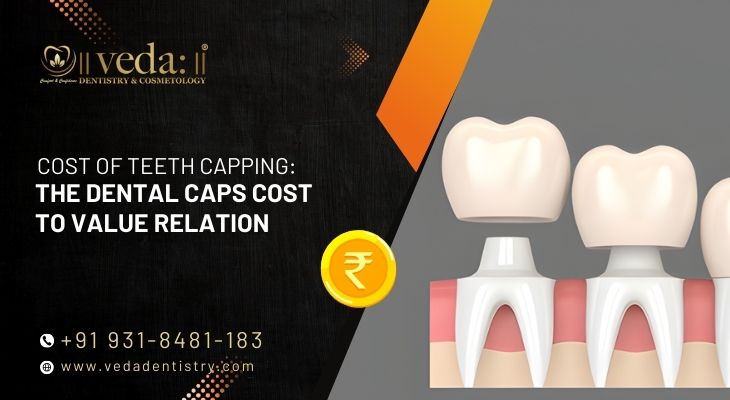
If you’ve ever Googled “Cost of Teeth Capping,” you already know the internet turns this simple question into a full-blown research project. Suddenly, there are ceramic crowns, zirconia crowns, metal-fused crowns, temporary crowns, bridge crowns, and before you know it, you’re sitting there wondering if getting a tooth cap is as complicated as picking a new phone.
As a clinic offering dental crown treatment in East Delhi, we hear this exact confusion every day:
“Doctor… is teeth capping expensive?”
“Why do prices vary so much?”
“Is it even worth the money?”
So today, we’re breaking everything down for you. Let’s get started.
Before we talk money, we need to talk meaning.
A dental cap (also called a crown) is a strong, protective cover placed over a damaged, weak, chipped, root–canal–treated, or heavily filled tooth.
It acts like a helmet, keeping the tooth safe, strong, and functional.
Think of it like:
“If a filling is like patching a tyre, a crown is like replacing the rim.”
A crown protects your tooth from:
Fracturing
Sensitivity
Wear and tear
Reinfection after RCT
Chewing pressure
And if the crown is made well, it also enhances your smile.
That brings us to the big question…
Well, it depends.
Think of dental caps the way you think of glasses.
You get budget frames, mid–range frames, and premium ones.
All serve a basic purpose, but durability, comfort, and aesthetics differ.
Similarly, when patients ask us if teeth capping is expensive, we tell them:
Teeth capping isn’t costly; it’s customised.
Costs vary depending on:
The crown material
The complexity of the tooth
Whether it’s a single crown or part of dental crowns and bridges
Whether root canal treatment was done
Additional gum or foundation support needed
The technology used for designing the crown
In short, price variation isn’t random; it’s based on how much precision, work, and durability the crown needs.
Here comes the interesting part: crowns come in different “styles.”
Each type has its own pros, strengths, and price category:
1. Metal Crowns
2. Porcelain–Fused–to–Metal Crowns (PFM)
These are popular for balancing beauty + budget.
3. All-Ceramic or All-Porcelain Crowns
Perfect for smile–focused treatments.
4. Zirconia Crowns
These are the “luxury edition” of dental crowns.
Each type has its own value, which is why the cost differs.
There is no “best” crown for all, only the best crown for your tooth.
Because it needs more aesthetic accuracy: shade, shape, contour, all must match your natural smile.
The foundation may need strengthening, especially if the tooth structure is weak.
Because multiple units are connected, requiring higher precision.
Because it lasts longer, looks better, and is made with advanced technology.
So yes, the cost changes because the requirements change.
Absolutely.
And here’s why we say that with confidence:
A dental cap is not like buying a dress or a pair of shoes; it’s a medical prosthetic designed to protect your tooth for years. It needs:
Technical precision
Customized design
Biocompatible materials
Lab expertise
Exact fitting and bite adjustment
Long-term durability
A well-made crown gives you:
Normal eating again
A natural smile
Protection for a weakened tooth
Prevention from needing extraction later
Always remember:
“A crown today can save you from an implant tomorrow.”
That alone justifies its cost.
A weak tooth without a cap is like a weak wall without reinforcement; eventually, it gives up.
Without a crown, a tooth may fracture beyond repair. Implants or bridges cost significantly more.
No more sensitivity, discomfort, or chewing issues.
Your smile looks harmonious again.
With proper care, a crown can last a very long time, making it an excellent value for money.
When you visit us for dental crown treatment in East Delhi, here’s what we do:
We check the tooth condition, bite, and gum health.
Minimal shaping to fit the crown securely.
We match the color to your natural tooth shade.
Ensuring precision for a perfect fit.
So you can eat and smile normally meanwhile.
Adjusted to perfection for comfort and bite alignment.
Crown costs in Delhi vary depending on the type of material (metal, PFM, ceramic, zirconia), the tooth location, and whether additional procedures like root canal treatment or core buildup are needed. Each material comes with its own durability and aesthetic benefits, which influence pricing. After examining your tooth, we provide a detailed, transparent cost estimate that suits your needs.
There is no single crown that is “best” for everyone. Zirconia and ceramic crowns are excellent for front teeth because they look extremely natural, while PFM and metal crowns work well for back teeth that need strength. We help you choose the ideal option based on your tooth condition, bite, appearance goals, and lifestyle.
Yes! Once the crown is placed and settled, you can enjoy your regular meals without worry. Crowns are designed to function like natural teeth, so chewing feels comfortable again. We just advise avoiding extremely sticky or hard foods immediately after placement.
A high-quality crown can last several years with proper care. Good brushing, flossing, and dental checkups help maintain longevity. The lifespan also depends on the material used and your biting habits, but many crowns stay strong and functional for a decade or more.
The procedure is usually very comfortable. We ensure the tooth is numbed before preparation, and patients often say the experience feels similar to getting a filling. After placement, mild sensitivity may occur for a short time but settles quickly.
A dental crown is one of the best investments you can make for your oral health. It restores strength, prevents future damage, improves aesthetics, and lets you chew with confidence again.
If you’re considering dental crown treatment in East Delhi, our team at Veda Dentistry is here to guide you through every option, explain cost variations clearly, and help you choose the crown that offers the best comfort, strength, and longevity for your tooth.
Ready to restore your tooth with a durable, natural-looking crown?
Book your consultation at Veda Dentistry today; your smile deserves the best.
Book An Appointment