

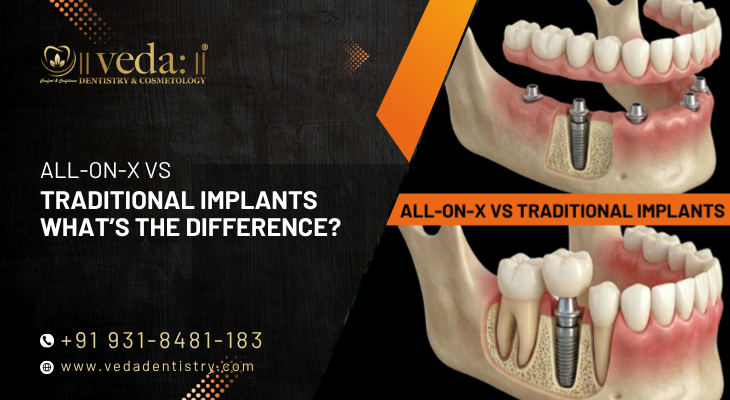
If you are considering dental implants for multiple missing teeth, you will likely come across two commonly recommended options: traditional dental implants and All-on-X.
At first glance, both treatments appear similar, they replace missing teeth, restore chewing ability, and improve smile aesthetics. However, they differ significantly in how they are planned, placed, and function over time.
Understanding these differences is essential. The right choice depends not only on how many teeth are missing, but also on bone availability, overall oral health, and long-term expectations.
Traditional dental implants are designed to replace missing teeth individually. Each implant is placed into the jawbone and supports a single crown, closely replicating the structure of a natural tooth,from root to visible surface.
This approach allows for highly precise, tooth-by-tooth replacement. It is often considered the gold standard when one or a few teeth are missing, as it preserves spacing, maintains natural function, and avoids involving adjacent teeth.
Because each tooth is replaced independently, treatment may involve multiple implants and is usually carried out in stages. Healing time is required between placement and final restoration to allow the implant to integrate with the bone.
All-on-X is a full-arch implant solution designed for patients who are missing most or all teeth in the upper or lower jaw.
Instead of placing an implant for every missing tooth, 4 to 6 strategically positioned implants are used to support an entire fixed set of teeth. These implants are often angled in specific directions to maximise contact with available bone and improve stability—especially in areas where bone volume may be reduced.
The result is a full-arch prosthesis that is fixed in place, meaning it does not need to be removed like traditional dentures. This provides improved comfort, function, and confidence.
Number of Implants
Traditional implants follow a one-to-one approach—one implant for each missing tooth. This can result in multiple implants when several teeth need replacement.
All-on-X, on the other hand, uses fewer implants (typically 4–6) to support an entire arch. This reduces the number of surgical sites while still providing a stable foundation for a full set of teeth.
Treatment Time
Traditional implant treatment is usually carried out in phases. After implant placement, a healing period is required before the final crowns are attached. This process can take several months depending on individual healing and case complexity.
All-on-X is often designed to provide faster functional results. In many cases, a provisional fixed set of teeth can be placed shortly after surgery, allowing patients to regain function and aesthetics more quickly.
Traditional implants may involve multiple implant placements across different areas of the jaw. If bone is insufficient, additional procedures such as bone grafting may be required.
All-on-X uses strategic implant positioning, often angled to utilise existing bone and avoid the need for extensive grafting. This can make the procedure more efficient and less invasive for suitable candidates.
Choosing between traditional implants and All-on-X depends on individual clinical needs.
Traditional implants are typically suitable for:
A thorough evaluation is essential to determine which option offers the best balance of stability, function, and long-term success.
At Veda Dentistry, implant treatment is planned with precision and individualisation. We begin with detailed diagnostics, including 3D imaging and digital planning, to assess bone quality, anatomical structures, and bite relationships.
Both functional and aesthetic factors are carefully considered before recommending a treatment approach. Whether the solution involves traditional implants or an All-on-X system, the focus remains on long-term stability, comfort, and predictability.
Our goal is not just to replace missing teeth, but to restore a healthy, functional smile that lasts.