

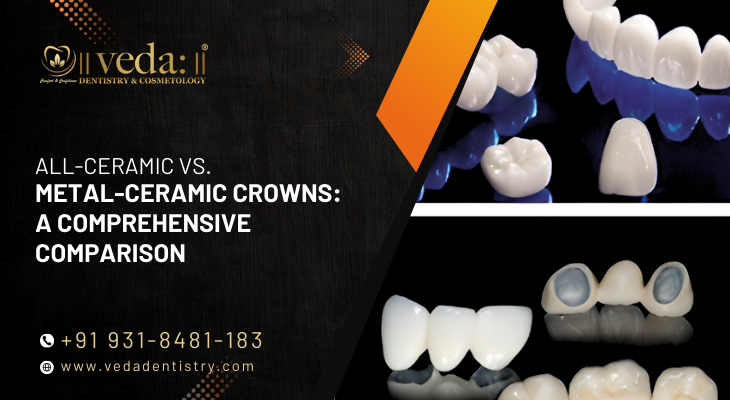
So, your dentist says you need a crown. It's a common recommendation, but suddenly you're faced with a choice: all-ceramic or metal-ceramic? It's not just about fixing a tooth; it's about what fits your life, your smile, and your health for years to come. Understanding the difference between Ceramic vs. Metal-Ceramic Crowns is the key to making a decision you'll be happy with every single day. This isn't about which one is universally "better", it's about which one is better for you.
Let's break down this important choice without the confusing jargon. Think of it as comparing two types of car engines: both will get you where you need to go, but they offer different experiences, performance, and looks. At Veda Dentistry, we'll walk through the details side by side so you feel informed and confident in your next step with your dentist.
This is the fundamental split. The materials define everything about the crown.
The presence or absence of that metal core is what leads to all the other differences in how they look, feel, and function in your mouth.
For teeth that show when you smile, appearance is often the top concern.
All-Ceramic Crowns:
Metal-Ceramic Crowns:
If a perfectly seamless, natural blend with your other teeth is your priority, all-ceramic options typically provide a superior aesthetic result.
You need a crown that can handle the daily workload of chewing and biting.
Metal-Ceramic Crowns:
All-Ceramic Crowns:
For most patients today, high-strength all-ceramic crowns are perfectly durable for any tooth in the mouth.
Your dentist must reshape your existing tooth to make room for the crown to fit over it.
Metal-Ceramic Crowns:
All-Ceramic Crowns:
Preserving your natural tooth is always a goal, and all-ceramic crowns often support that principle better.
This is about how the materials interact with your mouth.
All-Ceramic Crowns:
Metal-Ceramic Crowns:
For long-term tissue health and compatibility, ceramic is the gold standard.
From the first visit to the final placement, the steps are similar but can vary slightly.
The process for both involves: preparing the tooth, taking a digital scan or impression, placing a temporary crown, and then cementing the final crown at a second visit.
Generally, the timeline from start to finish is comparable, often 1-2 weeks between appointments.
This is a practical factor for many patients.
It's important to discuss costs, ceramic vs. metal-ceramic crowns, and payment options directly with your dental office, as these can vary.
Q: Can I get an all-ceramic crown on a back molar?
A: Absolutely. With modern materials like zirconia, all-ceramic crowns are incredibly strong and are a fantastic, metal-free choice for molars. They combine great strength with excellent aesthetics.
Q: Do metal-ceramic crowns cause grey lines at the gums?
A: They can, especially over time if your gumline recedes slightly. A well-made crown with a high-quality porcelain margin can minimize this, but it is a potential aesthetic drawback compared to all-ceramic.
Q: Which type of crown lasts the longest?
A: Both are designed to last many years, often 10-15 years or more with good care. Longevity depends more on your oral hygiene, habits (like grinding), and the skill of the dentist and lab than solely on the material
Q: Is one better for people who grind their teeth?
A: For severe teeth grinding (bruxism), the extreme strength of a metal-ceramic crown's core can be an advantage. However, many dentists now successfully use ultra-strong monolithic zirconia crowns for grinders, often paired with a protective nightguard.
Q: Will my dental insurance cover an all-ceramic crown?
A: Many plans cover all-ceramic crowns for front teeth for aesthetic reasons but may only cover the cost equivalent of a metal-ceramic crown for back teeth, leaving you responsible for the price difference. Always check your specific plan details.
Choosing between Ceramic vs. Metal-Ceramic Crowns ultimately comes down to your personal priorities. If your main goal is the most natural-looking, biocompatible option and budget is less of a concern, an all-ceramic crown is likely your best path. If you need a supremely durable, cost-effective solution for a less-visible back tooth and have no metal sensitivities, a metal-ceramic crown remains a trusted and reliable workhorse.
There is no "one-size-fits-all" answer. The best decision is made in partnership with your dentist, who can assess your specific tooth, your oral health, and your goals. Share your concerns about aesthetics, sensitivity, and budget openly. At Veda Dentistry, with clear information and an honest conversation, you can choose the crown that will protect your tooth and let you smile with confidence for years to come.
Visit:
Name:Veda Dentistry and Cosmetology
Address: 12, in front of Karkardooma Court Metro Station, Arjun Gali, A G C R Enclave, Anand Vihar, Delhi, 110092
Phone: +91 9318481183